
निवेशक डी-एन-ए · for SEBI-registered investment advisers
Behavioral fit, before the portfolio.
InvestorDNA is a four-part behavioral risk-profiling tool for SEBI-registered investment advisers — a risk-profiling record that supports the adviser's Regulation 16 process, and a plain-language profile for the client, from one 20–25 minute assessment.
Illustrative sample · fictional persona
निवेशक डी-एन-ए · 6 questions · 90 seconds
See how the assessment feels
Six sample questions from the four parts InvestorDNA looks at. This preview does not profile you or assign an archetype, and nothing you choose is stored or sent. It is not investment advice.
Levels, archetype and findings come from fixed, versioned rules. A language model drafts some report wording from coded findings only; it never receives a client’s name, answers or amounts. The adviser reviews every report.
चार पहलू · Four Parts
What the assessment measures
Four parts: risk appetite (willingness to accept loss, from the client’s choices); cash-flow resilience and obligations (ability to bear loss); decision context (knowledge, experience and how decisions are made). No single combined score is produced; the four parts are read together. The archetype describes how the client approaches decisions; cash flow and obligations decide how much room those decisions have.
₹10,00,000 for certain — or a 50-50 flip between ₹25,00,000 and ₹0.
लाभ और हानि
Risk appetite
How do you weigh a possible loss against a possible gain?
Instead of asking clients to rate themselves on a scale, the assessment offers choices between two rupee scenarios, sized to the income band given at sign-up, with what a bank fixed deposit offers shown as a familiar yardstick. It looks at how much a possible loss weighs compared with a gain of the same size, how very small and very large chances feel, and how clients describe their own approach to risk. The scenarios are hypothetical: no money changes hands.
From the 6-question preview
“Choose one. ₹10 lakh for certain. OR a 50-50 coin flip between ₹25 lakh and ₹0.”
Same bucket, different drip patterns — steady, gush, irregular, or rare floods.
आय और बचत की लय
Cash-flow resilience
Your client sees: Cash-flow rhythm
How steady is the money coming in, and what cushion sits behind it?
Two clients with the same ₹40 lakh annual income are not the same client. The salaried one gets ₹3.3L on the 1st of every month. The business owner gets ₹15L in March, ₹2L in April, ₹0 in May, ₹8L in June. This part looks at how steady income is, the cushion a household could live on if income paused — including the family gold many households treat as a reserve — how much of each month goes to EMIs, how money would be raised in a hurry, and when invested money will be needed.
From the 6-question preview
“Pick the statement closest to your reality.”
Of every ₹100, how much is already locked — EMI, school, premium, parents, household?
ज़िम्मेदारियाँ
Obligations
Your client sees: Responsibilities
How much of your money is already spoken for before it arrives?
In many Indian families, a good part of the money is spoken for before any investing decision is made. This part covers loans and EMIs, the people who depend on the client, family milestones such as weddings, higher education and a home, care for parents and elders, and giving — and, for each, whether it could bend if money got tight. Questions use ranges and wording such as “many families…”, so no answer feels like a confession. The assessment never asks about dowry, caste, or which faith or community a client belongs to.
From the 6-question preview
“Of every ₹100 you earn in a month, roughly how much is already committed before it arrives — EMIs, school fees, premiums, support to family?”
Years invested, the markets lived through, and what has been learned along the way.
निवेश यात्रा
Decision context
Your client sees: Investing story
What experience and knowledge do you bring to each decision?
The context the other three parts are read in: stage of life, how long the client has invested and in what, whether they have stayed invested through a sharp market fall, what they understand about compounding, inflation and diversification, how they like to receive information, and how money decisions are made at home. The client’s profile tells this as their own story and never compares them with anyone.
From the 6-question preview
“When you make a meaningful financial decision — say, ₹5 lakh+ — what's true about the conversation around it?”
द्वि-उत्पाद · Dual Output
One assessment, two outputs
The client gets a plain-language profile with no scores and no product suggestions. The adviser gets the record behind it: levels, evidence and points to discuss. Both come from the same 20–25 minute assessment.
Illustrative sample · fictional persona
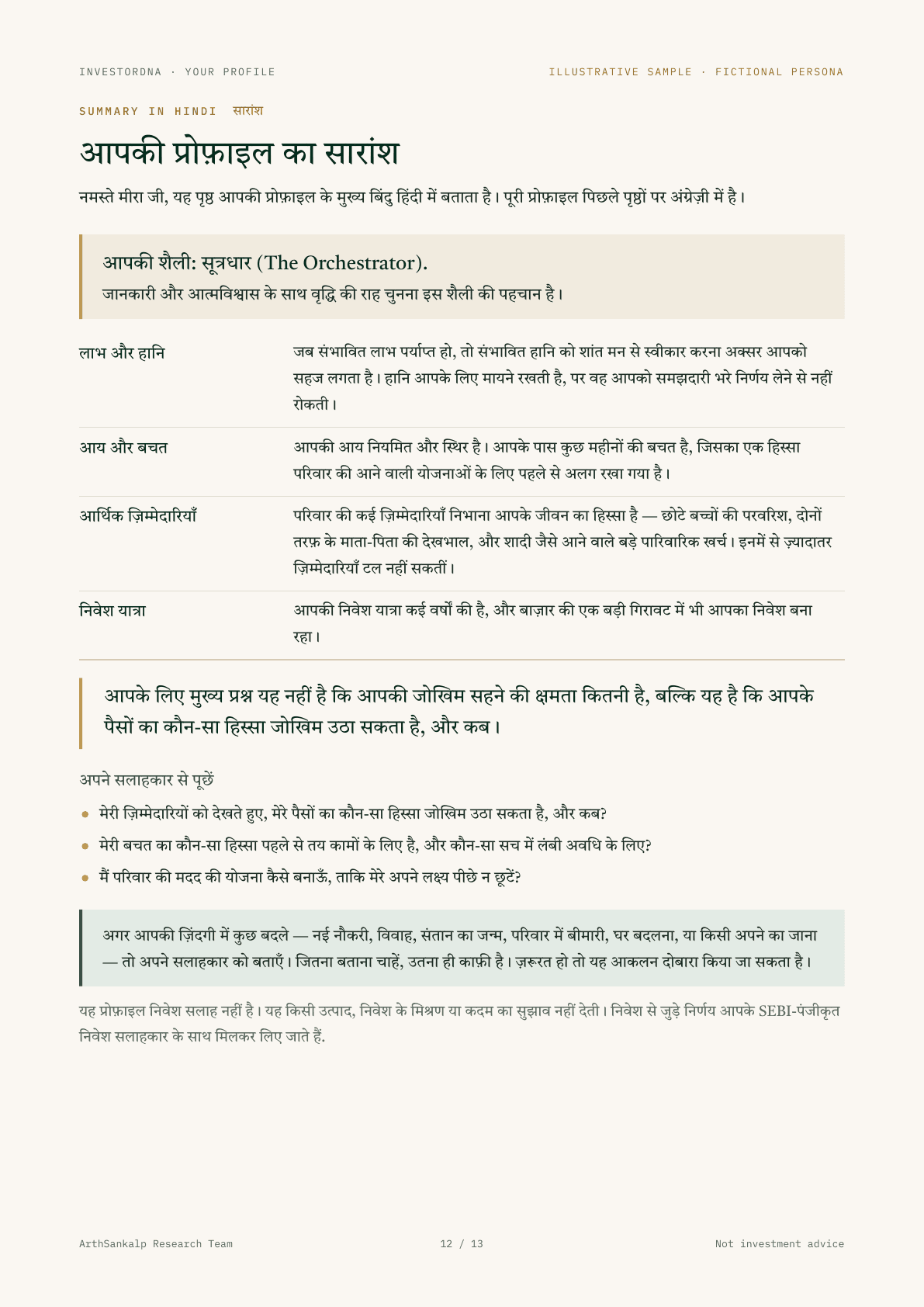
Client edition · Your InvestorDNA profile
Prepared for Meera Joshi (fictional) · Adviser: Anjali Rao (fictional)
सूत्रधार
Sutradhar
The Orchestrator
You pursue growth with informed confidence.
Your profile at a glance
- How you weigh gains and lossesOpen
You can sit with the possibility of a loss when the possible gain is worth it.
- Your cash-flow rhythmSteady
A steady salary and a real cushion, part of which is already promised to family plans.
- The responsibilities you carrySubstantial
You hold many family responsibilities, and most of them are the kind that do not bend.
- Your investing storySeasoned and at ease
Years of investing, including staying the course through a sharp market fall.
A question to take to your adviser
“Given my responsibilities, which part of my money can take risk, and when?”
No scores. No product suggestions. English, with a Hindi summary.
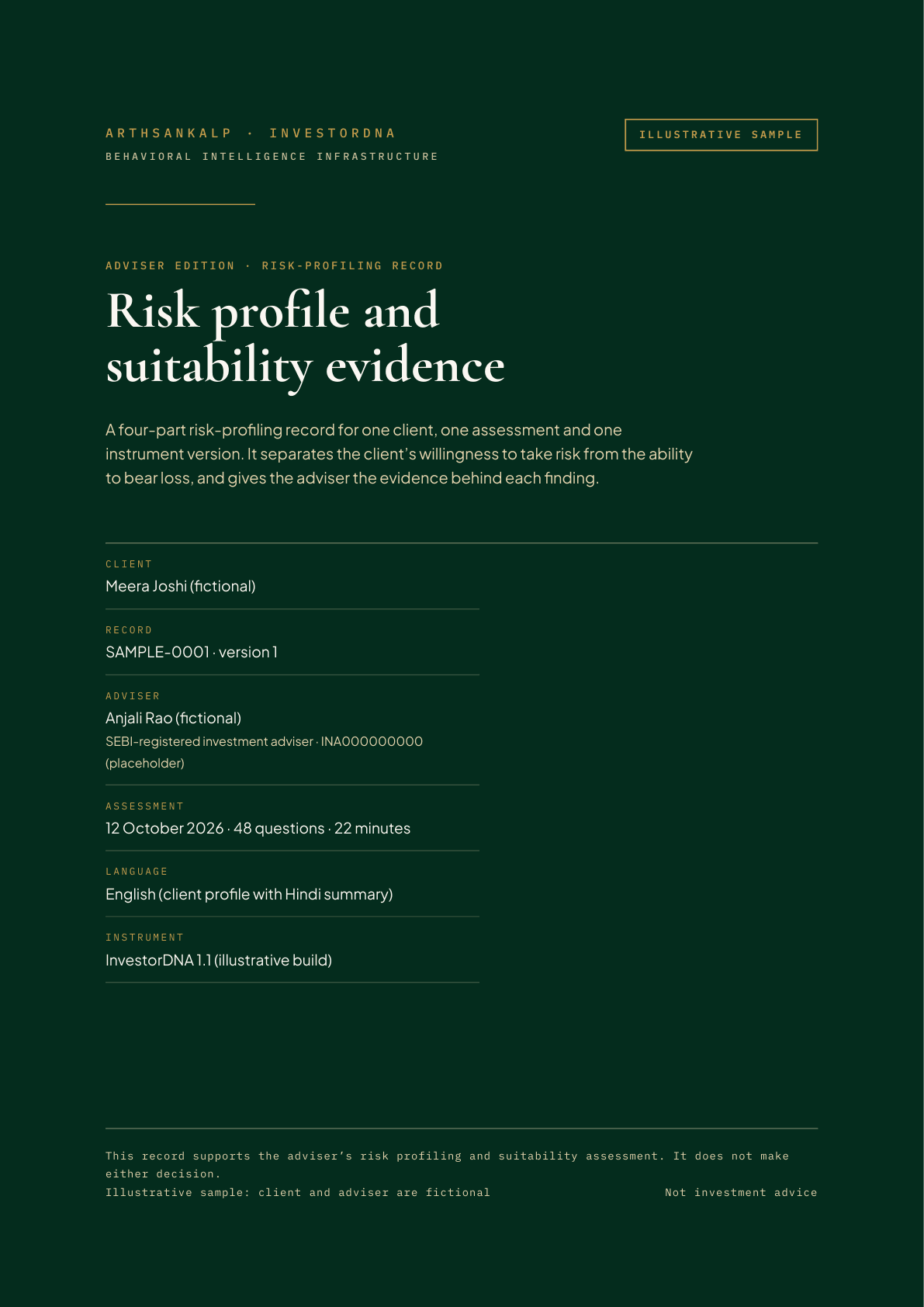
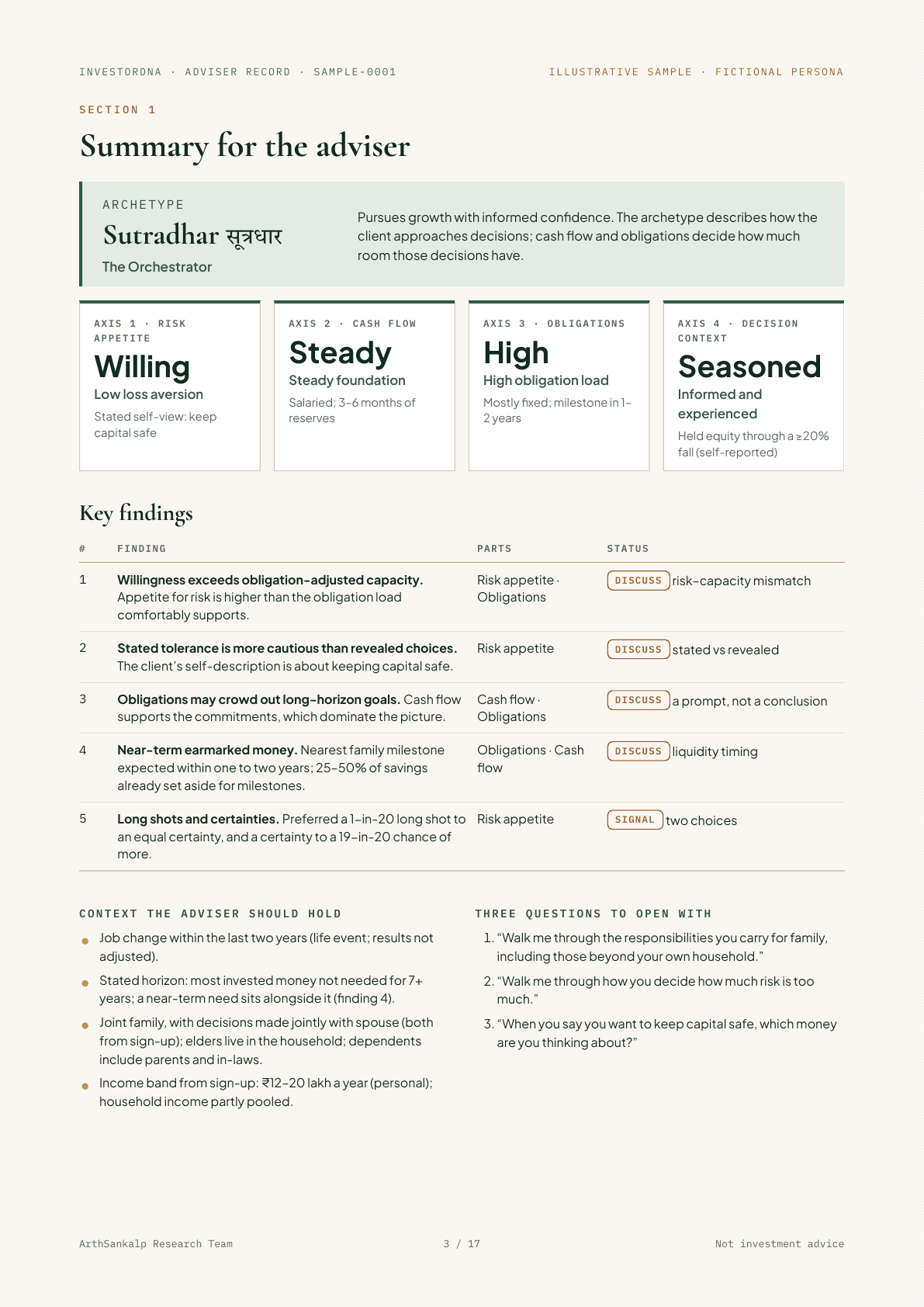
Adviser edition · Risk-profiling record
Client: Meera Joshi (fictional) · Record SAMPLE-0001 · 48 questions · 22 minutes
Sutradhar · The Orchestrator
ARCHETYPERisk appetite
Willing
Low loss aversion
Cash-flow resilience
Steady
Steady foundation
Obligations
High
High obligation load
Decision context
Seasoned
Informed and experienced
Key findings
- DISCUSSWillingness exceeds obligation-adjusted capacity — discuss
- DISCUSSObligations may crowd out long-horizon goals — a prompt, not a conclusion
- DISCUSSNear-term earmarked money — liquidity timing
Also in the record: the evidence behind each finding, how the profile is made and its limits, a regulatory map and the adviser's sign-off.
This record supports the adviser's risk profiling and suitability assessment. It does not make either decision.
Adviser edition · revision 4.1
Client edition · revision 3.2

Levels, archetype and findings come from fixed, versioned rules. A language model drafts some report wording from coded findings only; it never receives a client’s name, answers or amounts. The adviser reviews every report.
प्रमाण · Provenance
Method and provenance
The research and the rules InvestorDNA is built on, and its limits.
Prospect Theory: An Analysis of Decision Under Risk
Kahneman & Tversky · Econometrica, 1979
The loss-aversion architecture. InvestorDNA's Risk Appetite axis measures the structural asymmetry between gains and losses — a ₹1 lakh loss hurts roughly twice as much as a ₹1 lakh gain feels good (Tversky & Kahneman, 1992).
SEBI (Investment Advisers) Regulations, 2013 — Regulations 16 and 17
Securities and Exchange Board of India · sebi.gov.in
Regulation 16 requires the adviser to profile each client's risk, using tools that are fit for purpose and whose limitations are identified and mitigated. Regulation 17 requires the adviser to assess suitability. InvestorDNA produces a risk-profiling record that supports the adviser's Regulation 16 process; the adviser remains responsible for the risk profile, the suitability assessment and the advice.
Digital Personal Data Protection Act, 2023 + DPDP Rules, 2025
Government of India · PIB November 2025 notification
Consent must be free, specific, informed, unconditional and unambiguous.
Method and limitations
Fixed, versioned rules: the same answers always give the same result.
- Answers are self-reported, and the rupee scenarios are hypothetical; behavior with real money can differ.
- A profile is a point-in-time view.
- Re-assess after material life changes, and periodically.
- The record supports the adviser’s judgment; the adviser decides.
A detailed method-and-limitations note is provided to subscribing advisers, and to regulators on request.
How the profile is made, and its limitsउत्पाद प्रवाह · Product Flow
Two interfaces from one behavioral profile.
The same interaction produces an adviser-grade operating view and an investor-facing explanation view.
RIA workspace
A dashboard built for the adviser workflow.
Track profiling status, review each client's record and the points flagged for discussion, and know which investor needs a follow-up before the portfolio conversation.
Profile captured
01
Record reviewed
02
Client profile shared
03
RIA Console · Sample data
Client readiness
42
Profiles
11
Review
96%
Complete
A. Sharma
Risk–capacity mismatch
R. Mehta
Near-term milestone
N. Iyer
Record ready
Two clients need an adviser review before the portfolio conversation.
Founding cohort
₹999 a month, locked for 24 months.
For SEBI-registered investment advisers. The application form is on the page for advisers.
Apply to the founding cohortप्रश्न · Questions