
Financial Resilience Starts With Understanding Behavior
Understand how your clients decide — before the first portfolio conversation.
InvestorDNA is a 20–25 minute risk profile that a SEBI-registered investment adviser sends to a client before giving advice. The adviser gets a risk-profiling record that supports their Regulation 16 process. The client gets a plain-language profile of their own.
Designed around SEBI IA Regulations 16–17 · Fixed, versioned rules · Built in India
The investor’s problem
Three moments where today’s system lets the investor down.
1 · Before a decision
“Do they know me?”
Investors are typically profiled on a short form of self-ratings before they are advised or sold a product. None of the forms we read in full counts family obligations — parents’ care, weddings, siblings.
Only 27% of investors considered their risk appetite before investing, and 53% are not confident of their own assessment.
SourceAxis Mutual Fund investor survey, n = 1,740, September 2023
InvestorDNAFounding cohort
2 · Between decisions
“Does my plan move with my life?”
A job loss, a marriage, a child or a parent’s illness arrives between reviews, and the plan can break at the worst time.
Two of the institution forms we read in full state that a risk profile stays valid for two years.
SourceArthSankalp review of public risk-profiling forms, October 2026
PathGuardPlanned
3 · At the decision
“Will someone stop me?”
Emotion shows up in what investors actually do: exits in a fall, chasing last year’s returns, holding whatever they were handed.
In India’s IPO lotteries, 70% of winners held the stock on day one, against 0.7% of those who lost the lottery.
SourceAnagol, Balasubramaniam & Ramadorai, Review of Economic Studies (2018); 15 lakh investors
BiasShieldPlanned
Why forms miss it
A short form explains little of how people actually take risk.
Risk questionnaires used in practice typically explain less than 15% of the differences in how much risk investors hold.
SourceKlement, “Investor Risk Profiling: An Overview”, CFA Institute Research Foundation (2015)
The forms we could read in full have five or six items each: facts, self-ratings or “what would you do if markets fell 20%”. None asks for a real choice, and none counts what the family already owes.
SourceArthSankalp review of three public institution risk forms, October 2026
How investors describe their tolerance for risk tends to run above the risk they actually take.
SourceThompson, Feng, Reesor, Grace & Metzler, Financial Planning Review (2022)
What InvestorDNA measures
Four parts. Two outputs.
Risk appetite
Willingness to accept loss, from the client’s choices.
Cash-flow resilience
Your client sees: Cash-flow rhythm
Ability to bear loss: the cash flow that absorbs a shock.
Obligations
Your client sees: Responsibilities
Ability to bear loss: the commitments that claim money first.
Decision context
Your client sees: Investing story
Knowledge, experience and how decisions are made.
For the adviser
The risk-profiling record
A level for each part with the evidence behind it, findings marked Discuss or Signal, three questions to open the meeting, how the profile is made and its limits, and the consent and sign-off record.
For the client
Their own profile
Their style, their strengths and questions to take to their adviser, in plain language. There are no scores in it and no product suggestions.
Illustrative sample · fictional persona
See both editions of one assessment.
Adviser edition · revision 4.1
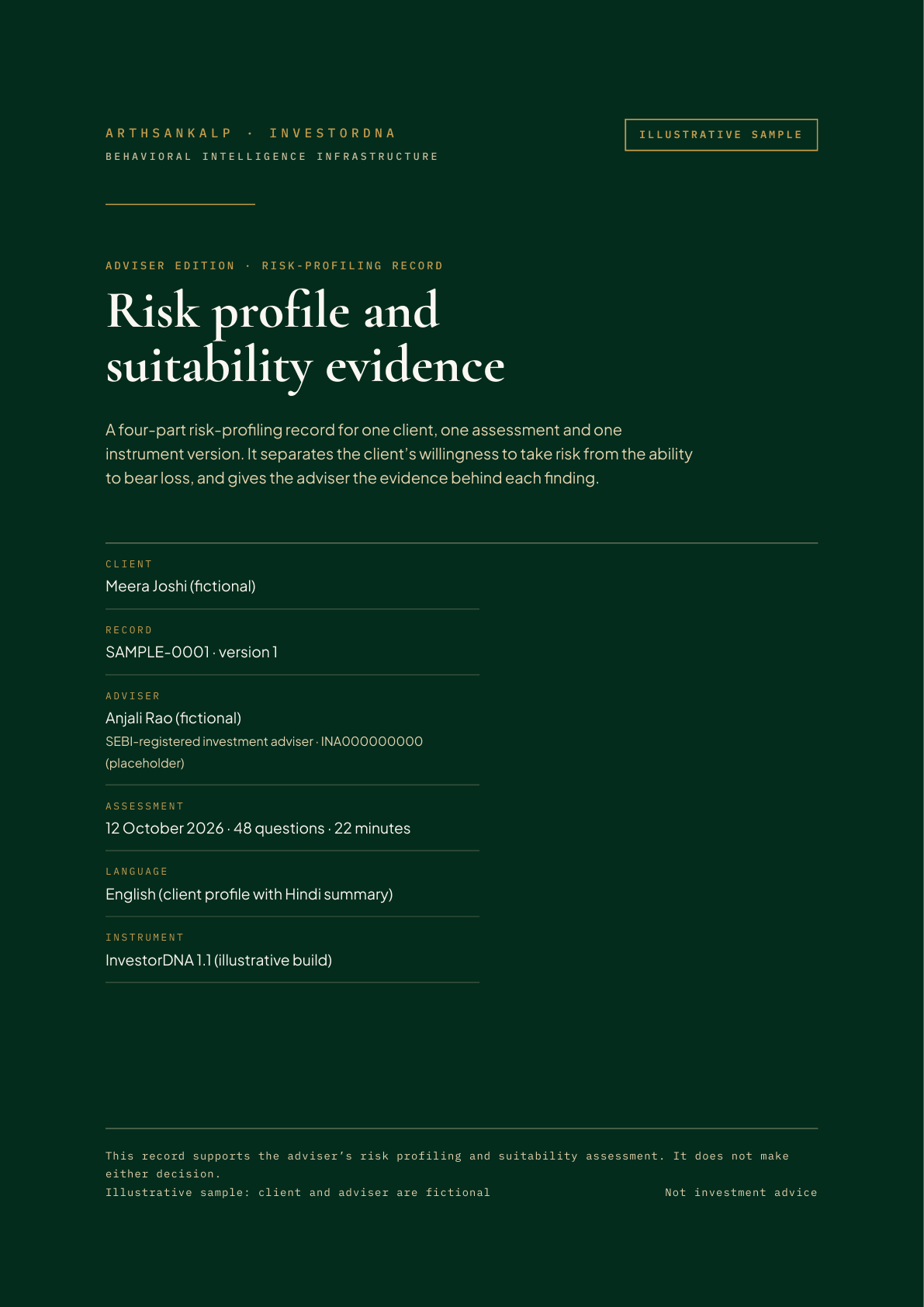
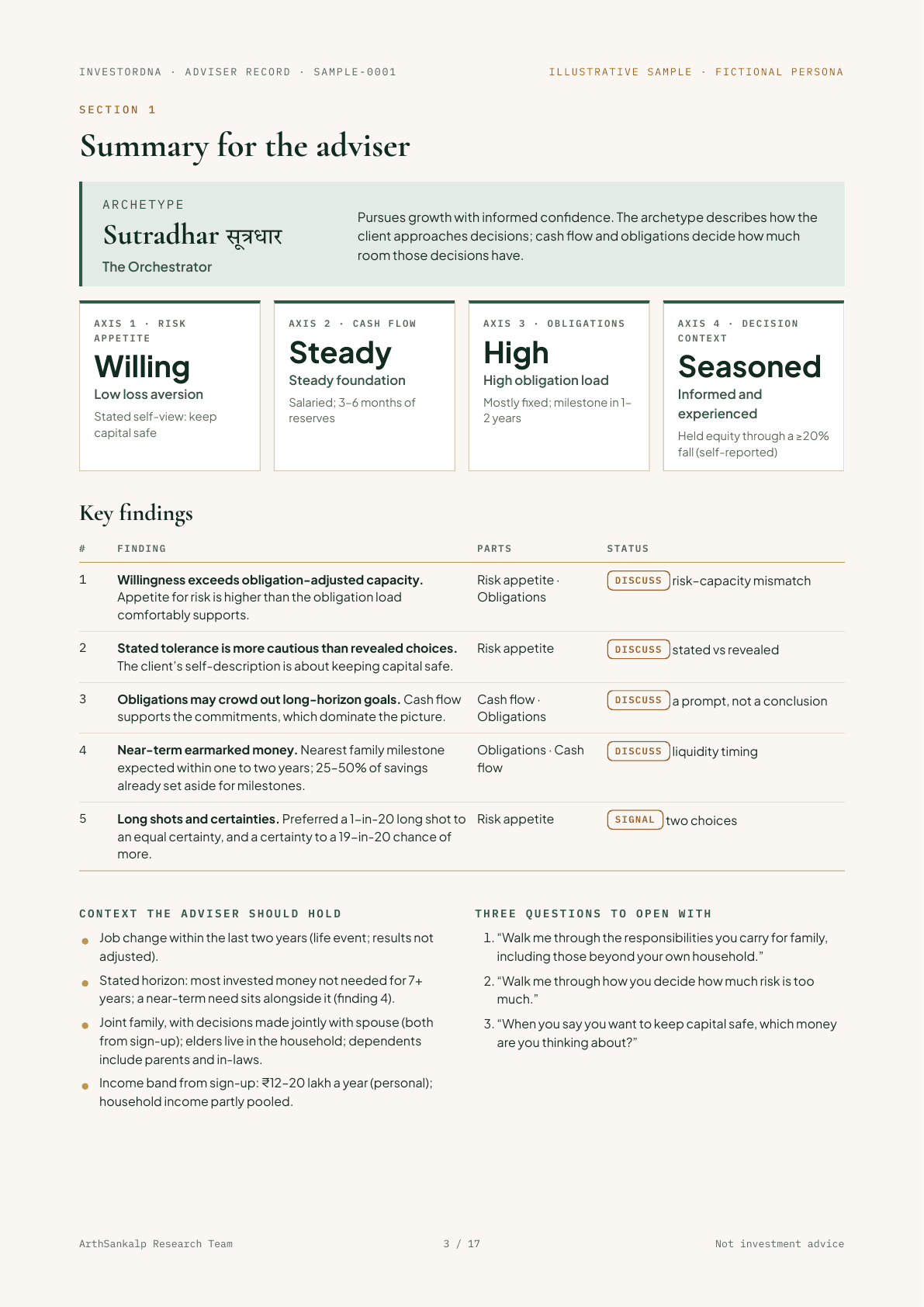
Client edition · revision 3.2


Levels, archetype and findings come from fixed, versioned rules. A language model drafts some report wording from coded findings only; it never receives a client’s name, answers or amounts. The adviser reviews every report.
How we work
What you can rely on.
Fixed, versioned rules
The same answers always give the same result. No artificial-intelligence tool computes or adjusts any result. The adviser reviews every record.
A clear AI boundary
A language model helps word some narrative paragraphs, working from coded findings only. It never receives the client’s name, contact details, answers or amounts.
Consent, step by step
The client makes separate choices to take the assessment, to share the results with their adviser and to receive their profile.
Limits in adviser terms
Answers are self-reported and the rupee scenarios hypothetical. A profile is a point-in-time view; re-assess after material life changes and periodically. The adviser decides.
The detailed note, on request
A detailed method-and-limitations note is provided to subscribing advisers, and to regulators on request.
Where to start
Choose your door.
For advisers
Profile clients before the first meeting
For SEBI-registered investment advisers. Start the meeting from the client’s own answers and keep the record.
For advisersFor partners
One loop per institution
For MFD platforms, portfolio managers, wealth managers, insurers, banks and NBFCs, for their own investors.
For partnersFor investors
A short reflection on how you decide
A few questions, nothing stored or sent, and questions to take to your adviser.
For investors